
DLD and socio-emotional development
Children and adolescents with DLD often experience more social and emotional problems than children without DLD. This is not surprising. Language plays a crucial role in socio-emotional development. Language affects your behaviour and the formation of your identity.
Language and socio-emotional development
Young children often struggle to express themselves. They get angry or upset when other people do not understand them. This often changes when they start using their first words and phrases. Then, children get better at saying what they mean.
Language is essential to describe our experiences. And to learn about the world and ourselves. But language is most important to get in touch with others. For example to:
- Express your thoughts, opinions and emotions
- Ask a question
- Engage in conversations or discussions
- Understand jokes from friends
- Participate in a game
- Collaborate and negotiate
DLD and social development
Social development involves learning how to interact with others. This can be very challenging for children with DLD. How do you talk to with others when your vocabulary is limited? How do you participate in a conversation when you do not understand what others are talking about? How do you express yourself in a discussion when you are constantly trying to find the right words? Or when you cannot convey your intent?
TIP
You can help a child with DLD in social interactions by sharing your own observations. For example: “I see you would like to join in”. And by demonstrating how to say things. For example: “Maybe you could ask: can I join in?”.
Various trainings exist to enhance social skills, such as de Kanjertraining. Your general practitioner can refer you to such programmes. Sometimes schools use these trainings to combat bullying.
It could be very beneficial for children and adolescents with DLD to talk with peers who also have DLD. Contact organisations like SamenTrOtS (7-14 y/o) or SpraakSaam (12-30 y/o).
DLD and emotional development
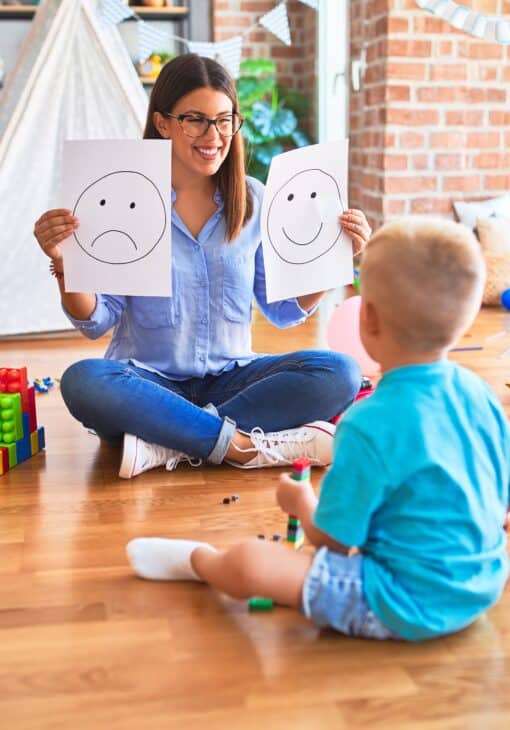
Emotional development relies on the ability to recognise emotions. And the ability to name
emotions. Eventually, children have to learn how to manage their emotions. Children and adolescents with DLD sometimes find it difficult to recognise their own and others’ emotions. And often, they find it difficult to talk about their frustrations, sadness or anger.
TIP
Share what you feel or think. And ask your child to do the same. And share what you think might be going on with your child.
“I can tell by the look on your face that you are feeling sad”
“Look at your hands, your fists are clenched: I think that you are angry.”
Behaviour as a mirror
Does a child have difficulty in social interactions? Or is it hard for them to express themselves? Often this shows in a child’s behaviour. Children with DLD more regularly have behavioural problems than children without DLD.
What behaviours are noticable in your child?
- Some children with DLD tend to get angry, pick fights or act aggressively.
- Other children might withdraw. They become quiet, worry excessively or feel down.
Identity development (who am I?)
Children and adolescents discover who they are through interactions with others. Primarly with their parents when they are young. And increasingly with their peers when they grow older. Language is important for identity development. Because language allows us to express our feelings, wants, needs, thoughts and opinions. Children and adolescents with DLD sometimes find it hard to talk about such topics. And it is harder to discover who you are when you have fewer conversations with others.
The socio-emotional development is interconnected with brain functions other than language. On the page DLD and how the brain works you can find more information.
Back to overview